Do you own or service generators? KROM can help you in your investigation when you stand in front of a generator that keeps its secrets from you.
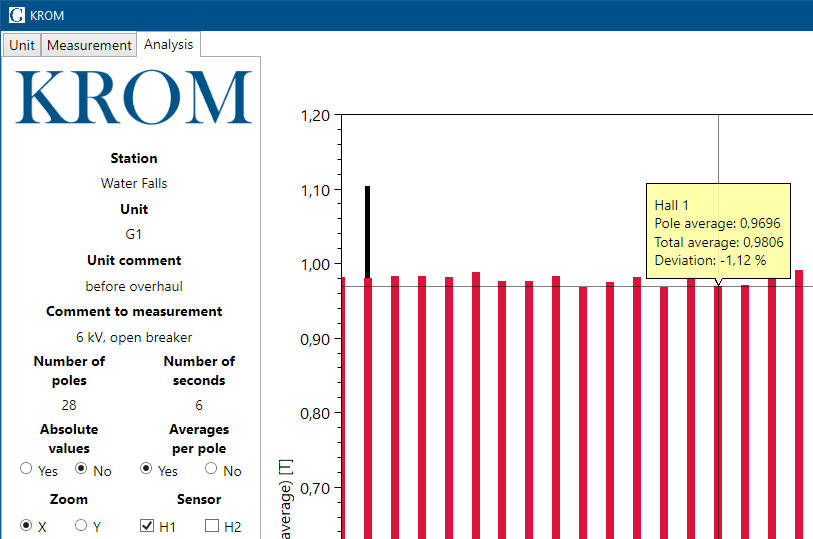
With a graph of the magnetic flux density you really know what is happening in the air gap at full speed. You can for example see the average flux density of each pole.
Why is it important to find faulty field windings?
A faulty field winding can cause vibrations an internal stator currents. Both will shorten the lifetime of a generator and, in the worst case, trip the generator and prevent any production. With KROM, you can perform magnetic flux measurements yourself, to verify the health of a field winding.
Average flux densities per pole can be compared.
How does KROM work?
KROM is based on Hall sensors, which measure the flux density directly. Coils measure the rate of change in flux density and give the highest signal between the poles. You want to see what is happening in front of each pole with no complex calculations between you and the signal.
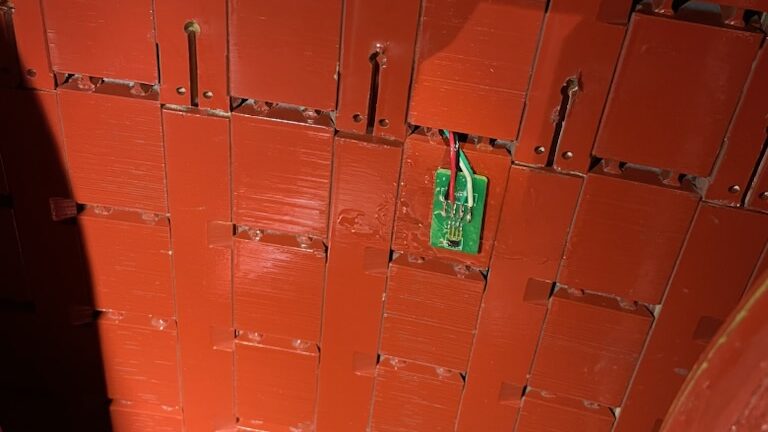
A Hall sensor glued to a stator tooth sees the radial flux density from the rotor poles.
What can KROM do that I can not achieve with a pole drop test combined with an RSO, repetitive surge oscilloscope, test?
KROM measures the magnetic flux during rotation at full speed. Hence, it detects field winding shortcuts caused by centrifugal forces.
With KROM you can also see the varying flux density in the air gap caused by a rotor with dynamic eccentricity, often called a whirling rotor.
You can read more about why you should have KROM in your toolbox here.
Click below to see some of the companies that have used KROM for fast and easy rotor diagnosis.